The Same Flag
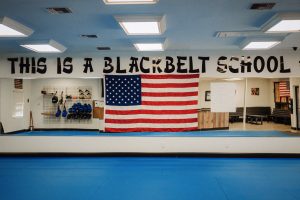
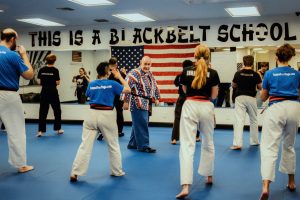
There was something about the dojo mirror yesterday.
It wasn’t really the mirror that caught my attention.
It was what was hanging over it.
An American flag.
Not just any American flag.
The same flag Grandmaster Stephen Del Castillo draped over the mirror in his dojo on September 11, 2001.
Twenty-five years later, it was hanging there again.
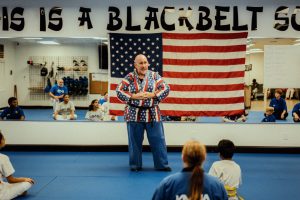
And in front of it, a new generation of students was training.
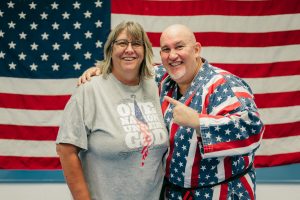
Grandmaster was wearing his Stars and Stripes gi, the patriotic uniform he brings out for occasions that carry special meaning. Against that American flag, the image was almost cinematic.
Yesterday was KMMA’s annual September 11 Commemorative Training—a tradition Grandmaster has held every year since September 11, 2001.
All four classes were led by Grandmaster, with members of his leadership team—Shihan and Sensei—helping with the classes.
The classes were different.
The students were different.
The skill levels were different.
But the message was the same.
And watching Grandmaster move from one class to another, I was reminded once again of something I’ve come to know about him: he has a remarkable ability to meet people exactly where they are and deliver the same powerful lesson in a way that speaks to each of them.
“Where Were You?”
He began each class with a question.
For those of us who were alive on September 11, 2001:
“Do you remember exactly where you were?”
He asked us to raise our hands if we did.
Hands went up throughout the room.
Then he told the students who weren’t alive that day to look around.
Look at all those hands.
Twenty-five years later, these people could still tell you where they were when they heard the news.
That was the first lesson.
For an entire generation, September 11 isn’t just a date in a history book.
It is a memory.
It is something that was permanently etched into their minds.
And for the younger students who weren’t born yet, Grandmaster was giving them a window into a day they could never have known firsthand.
Then he told us his story.
The Flag
Early in the morning of September 11, 2001, Grandmaster was alone in his first dojo practicing Kempo martial arts.
It was a small dojo—only about 1,000 square feet—tucked inside a strip plaza in Wesley Chapel that no longer exists.
Next door was a Marine recruiting office, where a Marine named Matt worked. Grandmaster called him “Matt the Marine.”
Matt was also his student.
After the first plane hit the North Tower, Matt came through the dojo door and called Grandmaster into his office to watch the television coverage.
As Grandmaster entered, the second plane hit the South Tower.
At first, he thought Matt was playing a practical joke.
It was almost impossible to comprehend.
America had never been attacked like this on its own soil.
Suddenly, Grandmaster had a decision to make.
Should he close the dojo?
Should he cancel the day’s classes?
He didn’t know what he should do.
So he prayed.
And God helped him come to the decision to keep the dojo open.
The answer became clear to him:
“My students may need me now more than ever.”
So he kept the dojo open.
Anyone who wanted to come in and train could.
He didn’t know if anyone would show up.
But if they did, he was going to be there for them and they were going to train.
Then he took an American flag and draped it over the little mirror in his dojo.
Yesterday, he joked that the flag looks small on our mirror now.
Back then, in that tiny dojo, he said, it looked massive.
And it is that same flag that hung over our mirror yesterday.
That day, some of his students did come.
And they trained.
They went on with the day as best they could, doing what they had always done—showing up, training, and refusing to allow fear and uncertainty to completely stop them.
Because, as Grandmaster explained, they realized that if they didn’t keep going, the terrorists would have won.
Twenty-five years later, he is still training his students on that day.
The Video
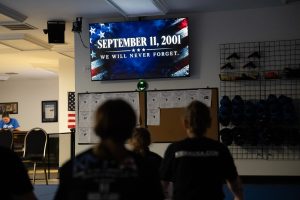
About 25 minutes into each class, Grandmaster had us lock it up.
The energy in the room shifted.
We stopped training and watched a video he had narrated, his powerful reflection woven through a collection of photographs and news footage from that day—moments of devastation, courage, service, sacrifice and, eventually, healing.
The video touched on the courage and character revealed in moments of crisis, and Grandmaster briefly introduced the idea of the crucible.
But the fuller meaning of that word would come later.
For now, we went back to training.
Don’t Stop
My Intermediate class had 40 or more people packed onto the mat.
The energy was incredible.
The room was electric.
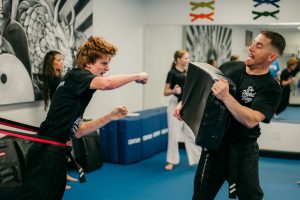
Because our class was so large, we worked in groups of three—one person holding the pad while two took turns punching.
There was no stopping.
You punched.
And punched.
And punched.
Observing this drill in the previous class, I watched students sweating onto the mat. Some looked utterly exhausted.
But in my class, I wasn’t watching anymore.
I was in the middle of it.
The longer it went, the more difficult it became.
At one point, I stopped for just a moment.
I was tired. I felt like I couldn’t breathe.
I had no idea Grandmaster was standing right beside me.
He shouted at me, “DON’T STOP!”
So I didn’t.
I kept going.
Sometimes, you don’t know what you’re capable of until you’re pushed past what you thought was your limit.
Resistance
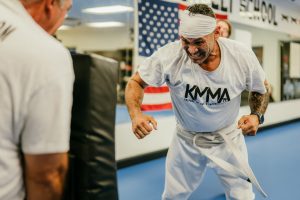
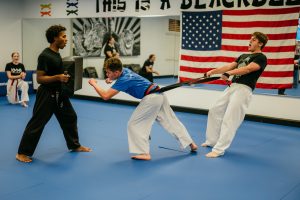
Then came the resistance drill.
One person holds the pad—the “meat.”
Another takes your belt, loops it around your waist and holds on—the “resistance.”
You are the fighter.
Your job is to keep moving toward the pad while someone is actively pulling you backward.
It is intense.
Every movement takes effort.
You punch.
You elbow.
You push.
You fight for every inch.
Sometimes you feel like you’re barely moving.
At times, you are almost climbing and clawing your way toward the pad, fighting for the ability to keep moving forward.
All around the room, Grandmaster, Shihan and Sensei were encouraging students to keep fighting through it.
And Grandmaster gave us another one of those statements that somehow says much more than it seems to:
“Resistance will always come. Of course it will. That’s life. The question is what you do when it does.”
As both a participant in that drill and an observer of it from outside my own class, I watched students being pulled backward as they fought to keep moving forward.
It wasn’t comfortable.
But we kept fighting.
The Crucible
Grandmaster brought us back to the lesson underneath everything we had just experienced.
The crucible.
A crucible is a severe test or trial through which someone is transformed.
It is also a container designed to withstand extreme heat while metals are melted and refined inside it.
It is an extraordinary analogy for leadership.
A crucible applies pressure.
It exposes weakness.
It reveals strength.
And, if we respond correctly, it can forge us into something stronger.
Grandmaster reminded us that the first responders and citizens who found themselves in the middle of September 11 had been thrust into their own crucible.
They didn’t know what was coming.
They couldn’t prepare specifically for that day.
But when the moment came, their character was revealed.
Because character isn’t created in a crisis. It is revealed by it.
And that is where the lesson became personal.
We don’t know what our own crucible will look like.
We can’t prepare for every possible illness, loss, financial crisis, professional challenge, relationship struggle, failure, disappointment or emergency.
We can’t predict the storm.
But we can prepare ourselves.
And suddenly, the training we had just experienced seemed to take on another meaning.
The exhaustion.
The resistance.
The decision to keep moving when everything in your body tells you to stop.
These weren’t just exercises.
They were opportunities to practice the response we hope to have when life gets hard.
Run Toward the Storm
Grandmaster told us a story about the cow and the buffalo.
When a storm approaches, the cow instinctively tries to run away from it.
But because it runs in the same direction as the storm, it can spend much longer inside the storm.
The buffalo reacts differently.
It charges toward it.
The buffalo doesn’t avoid the storm.
It goes directly into it—and because it is moving toward the storm, it gets through it more quickly.
Sometimes the only way through the storm is to face it.
That is why we train the way we do at KMMA.
The Blackbelt Crucible
During the Foundations class—which is made up of White and Yellow Belt students—Grandmaster told them about the Blackbelt class that would follow.
He told them that they had already experienced the KMMA Blackbelt Crucible.
He also told them something I understood firsthand. I was a Foundations student myself last March when I photographed the Blackbelt test, and I saw just how demanding it was.
“If a Foundations student walked into that Blackbelt test today, it would be intimidating.”
It is hard.
Very hard.
But Grandmaster reminded them that by the time it is their turn, they will be ready.
They won’t be the same students they are today.
The years of training and challenges will have prepared them.
The smaller crucibles along the way will have prepared them for the bigger one.
And even then, earning a Blackbelt isn’t the end of preparing.
It is preparation for everything that comes after.
Because the ultimate goal isn’t simply to survive a blackbelt test.
It is to become someone who is prepared to face life’s tests.
What I Saw
As a photographer, I was in every class yesterday—participating in one and documenting the others. I got to experience the training firsthand, and observe it.
What struck me most was that across all four classes, Grandmaster delivered the same message.
He made the lesson accessible to every person in the room.
September 11 inspired the training.
But he gave us something to carry forward:
Be ready.
Because character isn’t created in the crisis.
It is revealed by it.
Grandmaster teaches us the 90/10 rule:
10% of life is what happens to you, and 90% is how you react to it.
We prepare for that 90%.
We train when it’s hard.
We practice discipline when nobody is watching.
We learn to keep going when we’re under pressure, to push through resistance, to control ourselves and to lead.
So when life tests us, we have already practiced how to respond.
The Same Flag
At the end of each class, Grandmaster thanked his students for coming.
He reminded us why we were there.
To honor those who died.
To remember the first responders and citizens who ran toward danger.
To recognize the heroes of that time.
And to try to emulate their example by preparing ourselves for our own crucibles.
Standing there yesterday, I kept looking back at the flag.
The same flag.
The one that hung over the mirror in a tiny 1,000-square-foot dojo 25 years ago, on the morning America changed forever.
The flag that has been part of this September 11 tradition every year since.
And now, it hangs over a much larger dojo.
In front of it are generations of students.
Children who weren’t born when that flag first went up.
Adults who remember exactly where they were.
Blackbelts who have already faced their own physical crucibles.
Foundations students who are just beginning to learn what it means to push through something difficult.
And at the center of it all is the same man who, twenty-five years ago, decided that his students needed him.
I think that says a lot about Grandmaster Stephen Del Castillo.
He doesn’t simply teach leadership.
He lives it.
He doesn’t simply tell us to be prepared.
He has spent decades preparing people.
He doesn’t simply talk about courage.
He challenges us to practice it in small ways, long before we ever know whether we’ll need it in a big way.
And maybe that is one of the greatest gifts a teacher can give his students:
Not the promise that the storm won’t come.
But the confidence that when it does, we can face it.
Yesterday, we trained to honor the heroes of September 11.
We trained to remember.
We trained to reflect.
And we trained because we never know when our own crucible will come.
We don’t know what it will look like.
We don’t know what it will ask of us.
We don’t know who may someday need us to stand.
But we can prepare.
We can train.
We can become stronger.
And when the storm comes, we can face it.
In Grandmaster’s words: “We prepare for our crucible today, so that when it comes, we are ready.”
Christine Holtzman
Marketing Director
KMMAUSA.com
813-948-4844
ch****************@***il.com